About Epoxy Grouts
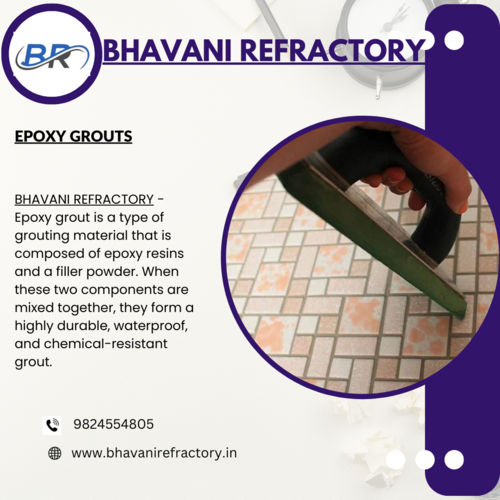
BHAVANI REFRACTORY - Epoxy grout is a type of grouting material that is composed of epoxy resins and a filler powder. When these two components are mixed together, they form a highly durable, waterproof, and chemical-resistant grout. Epoxy grouts are commonly used in various applications, particularly in environments where traditional cementitious grouts may not be suitable due to exposure to moisture, chemicals, or heavy traffic.
Here are some key characteristics and applications of epoxy grouts:
Waterproof: Epoxy grouts are inherently waterproof, making them ideal for use in wet environments such as showers, bathrooms, swimming pools, and other areas exposed to moisture.
Chemical Resistance: Epoxy grouts offer excellent resistance to a wide range of chemicals, including acids, alkalis, solvents, and oils. This makes them suitable for use in industrial settings such as laboratories, food processing facilities, and chemical plants.
Stain Resistance: Epoxy grouts are highly resistant to staining and discoloration, making them easier to maintain and clean compared to traditional cementitious grouts. They are particularly well-suited for use in areas prone to spills or heavy foot traffic.
Durability: Epoxy grouts are extremely durable and resistant to cracking, chipping, and crumbling. They can withstand heavy loads and are less prone to damage from impact or abrasion.
Low Porosity: Epoxy grouts have a low porosity, which means they are less susceptible to water absorption and staining compared to cement-based grouts. This helps to prevent mold, mildew, and bacterial growth in grouted areas.
Wide Temperature Range: Epoxy grouts can withstand a wide range of temperatures, from freezing cold to extreme heat, without degrading or losing their structural integrity. This makes them suitable for both interior and exterior applications.
Versatility: Epoxy grouts can be used with a variety of tile materials, including ceramic, porcelain, glass, and natural stone. They are available in a range of colors to match different tile installations and design aesthetics.
Installation: Epoxy grouts require careful mixing and application procedures to ensure proper curing and adhesion. They typically have a shorter working time compared to cement-based grouts, so it's important to work efficiently during the installation process.
Overall, epoxy grouts are valued for their superior performance and durability in demanding environments. They provide a long-lasting and aesthetically pleasing solution for grouting tile installations in residential, commercial, and industrial settings.
SPECIFICATION
|
Industries Served
|
Cement & Lime
|
|
Types Of Monolithic Refractories
|
Coating refractories
|
|
Types Of Refractories
|
Shaped Refractories
|
|
Method Of Manufacture
|
Dry Press Process
|
|
Service Charges
|
Yes
|
|
Location
|
All Over India
|
Superior Performance in Harsh EnvironmentsEngineered for industrial and heavy-duty applications, Epoxy Grouts deliver robust compressive strength and resistance against chemicals, moisture, and abrasion. These characteristics make them ideal for demanding settings such as industrial plants, pharmaceuticals, and laboratories, where durability, hygiene, and longevity are essential. Their non-shrink nature ensures stable, lasting installations even under heavy service conditions.
Versatile Application with Eco-Friendly FormulaFormulated as a two-component epoxy compound, this grout is available in a range of colors and pack sizes to suit different project needs. It is easy to mix and apply, with a pot life of up to 60 minutes and a full cure achieved within 24 hours. The product's low VOC content and non-toxic formulation provide safe handling and minimal impact on the environment.
Reliable Bonding for Multiple SubstratesWith high adhesion and tensile strength, Epoxy Grouts secure tiles, stones, and concrete with exceptional holding power. Suitable for joints 1-3 mm thick, they resist stains, water, and chemical exposure, making them perfect for tile joint filling, fixing stones, and high-traffic flooring in both new builds and renovations.
FAQ's of Epoxy Grouts:
Q: How do I mix and apply Epoxy Grout for best results?
A: To prepare Epoxy Grout, mix the resin and hardener components in a 2:1 ratio by weight until a uniform consistency is achieved. Use a clean container and a low-speed mixer. Apply the mixture within its 40-60 minute pot life at 27C, using a rubber grout float or trowel. Clean excess grout promptly and allow 24 hours for a full cure.
Q: What are the key benefits of using Epoxy Grout over conventional cement-based grouts?
A: Epoxy Grout offers superior chemical and abrasion resistance, low water absorption, non-shrinkage, stain proofing, and enhanced strength, making it ideal for demanding environments. It ensures lasting, hygienic joints in places where tiles or stones are exposed to chemicals, heavy traffic, or moisture.
Q: When is Epoxy Grout recommended for use in construction or industrial settings?
A: Epoxy Grout is recommended whenever high strength, chemical resistance, or water resistance are required, such as in bathrooms, commercial kitchens, pharma plants, factories, laboratories, and industrial floors. Its performance is optimal in joints between 1-3 mm and areas requiring robust adhesion and durability.
Q: Where can Epoxy Grouts be applied effectively?
A: Epoxy Grouts are suitable for use on tiles, stones, and concrete surfaces in both interior and exterior installations. Typical applications include tile joint filling, fixing tiles and stones, floor and wall tiling, heavy-duty flooring, and settings where chemical or thermal exposure is expected.
Q: What makes this epoxy grout environmentally friendly and safe for use?
A: This epoxy grout features a low VOC (volatile organic compounds) formulation and is non-toxic as per standard usage, ensuring safer air quality and minimal exposure risks during application. Its eco-friendly composition makes it suitable for spaces like hospitals, food processing, and pharmaceutical areas.
Q: What is the expected coverage, and how do joint width or substrate affect it?
A: Coverage varies depending on joint width, tile size, and surface texture. On average, approximately 1.5 kg/m2 is used for standard applications. Wider joints and larger tiles will require more material, so always calculate coverage based on specific site conditions for optimal results.
Q: How should Epoxy Grout be stored to maintain product quality?
A: Store the unopened epoxy grout in a cool, dry place at temperatures between 5C and 30C. Proper storage will maintain its shelf life up to 12 months. Ensure that the containers are sealed to prevent moisture ingress and contamination.




 Send Inquiry




 English
 Spanish
 French
 German
 Italian
 Chinese (Simplified)
 Japanese
 Korean
 Arabic
 Portuguese

 Send Inquiry

 Send Inquiry
 Send Inquiry
 Send SMS
 Call Me Free