About
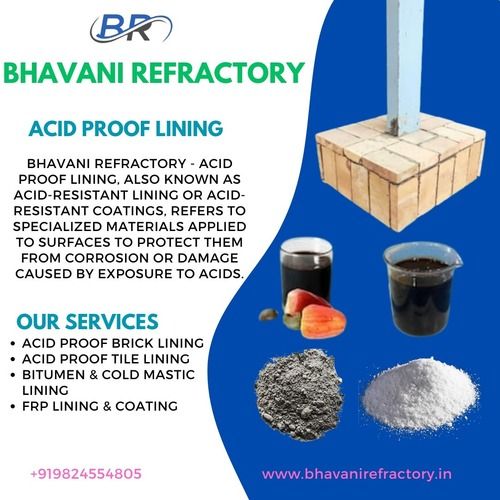
An acid-proof lining refers to a protective layer or coating applied to surfaces that are exposed to corrosive acids. These linings are commonly used in industrial settings where acids are handled or processed, such as chemical plants, metal refining facilities, and storage tanks.
- Rubber Lining: Rubber linings, typically made from synthetic rubber compounds like neoprene or butyl rubber, offer excellent resistance to a wide range of acids and chemicals. They are often applied as sheets or sprayed onto surfaces.
- Epoxy Coatings: Epoxy coatings provide a durable and chemically resistant barrier against acids. They are applied as liquid coatings that cure to form a hard, impermeable surface.
- Fiberglass Reinforced Plastic (FRP): FRP linings consist of a resin matrix reinforced with fiberglass. They offer good resistance to acids and are lightweight, making them suitable for lining tanks, pipes, and other structures.
- Vinyl Ester Linings: Vinyl ester linings combine the chemical resistance of epoxy resins with the flexibility and toughness of vinyl. They are often used in applications where exposure to acids and other corrosive substances is frequent.
- Ceramic Linings: Ceramic linings provide high resistance to abrasion and corrosion, making them suitable for harsh industrial environments. They are often used in combination with other materials for added protection.
Superior Resistance in Extreme EnvironmentsThe acid proof linings are crafted from high-quality acid refractory bricks that provide exemplary protection against aggressive chemical attack. Their irreversible dimensional stability ensures that the lining maintains its shape and effectiveness even under prolonged acidic exposure, minimizing maintenance needs and downtime.
Versatile Application Across IndustriesThese linings are widely adopted in the chemical and pharmaceutical industries across India due to their proven ability to safeguard equipment such as reactors, tanks, and pipelines. Their durability and efficiency make them a preferred choice among manufacturers, suppliers, and traders seeking reliable, long-term solutions for corrosion protection.
FAQ's of Acid Proof Lining:
Q: How is Acid Proof Lining with Dimensional Stability: Irreversible installed in industrial settings?
A: The installation process involves applying acid refractory bricks using specialized acid-resistant mortars on the surface that needs protection. Careful alignment and joint sealing ensure complete resistance to chemical infiltration. Professional installation ensures long-lasting and effective protection for the equipment.
Q: What are the primary benefits of using acid proof lining in the chemical and pharmaceutical industries?
A: These linings offer robust protection against chemical corrosion, prolong the lifespan of process equipment, and minimize costly repairs and downtime. Their dimensional stability guarantees that the lining retains its protective properties, even during extended exposure to acids and high operational stresses.
Q: Where in India can I source acid proof lining products and services?
A: You can obtain acid proof lining bricks and installation services from a range of manufacturers, distributors, suppliers, and service providers throughout India. Most operate in key industrial regions, catering to the specific needs of chemical and pharmaceutical units.
Q: When is acid proof lining necessary in process plants?
A: Acid proof lining should be considered whenever equipment, tanks, or structures are exposed to corrosive chemicals or acidic environments to prevent material degradation, leaks, and operational failures.
Q: What types of refractories are suitable for acid proof lining and why?
A: Acid refractory bricks are ideal for acid proof lining because they are engineered to endure chemical attack from acids and maintain their structure and function over time, unlike ordinary brick or concrete.
Q: How does the dimensional stability of these linings benefit industrial processes?
A: Dimensional stability means the bricks will not warp, shrink, or lose shape, providing consistent protection and structural support to vessels and pipelines, even under thermal or chemical stress.